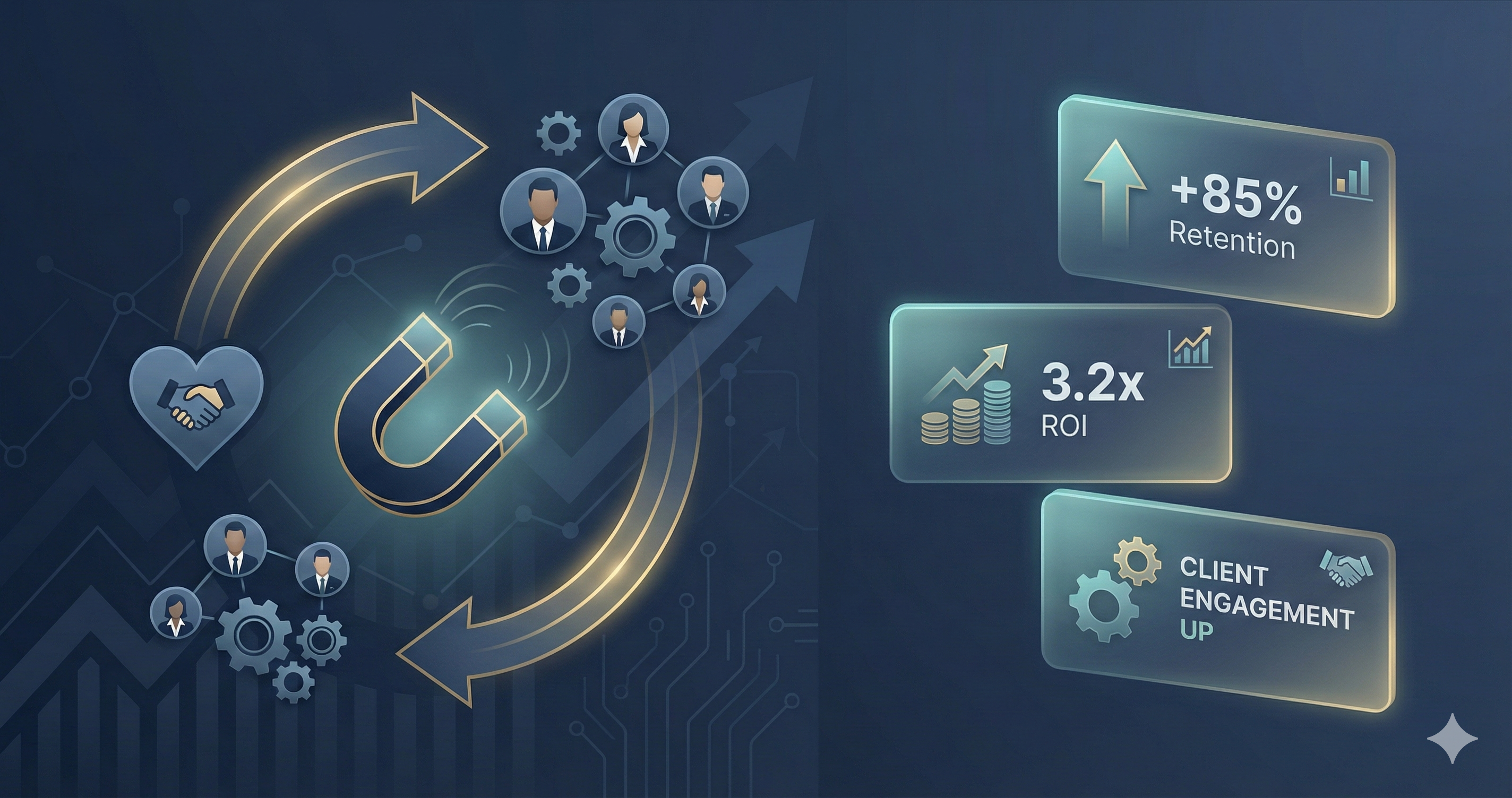
B2B Retention: The B2B Playbook
B2B retention is the strategic cornerstone that separates thriving enterprises from struggling ones. While most companies obsess over new client acquisition, the smartest B2B organizations recognize a fundamental truth: retaining existing clients costs 5-7x less than acquiring new ones, yet delivers exponentially higher lifetime value.
In this comprehensive playbook, you'll discover proven strategies for client engagement, systematic approaches to reduce churn, and actionable frameworks for B2B revenue expansion that leading enterprises deploy today.
Understanding B2B Retention Fundamentals
B2B retention differs fundamentally from consumer retention. Enterprise relationships involve multiple stakeholders, longer decision cycles, and significantly higher contract values.
A single lost B2B account can represent hundreds of thousands—even millions—in annual recurring revenue. This reality demands a sophisticated, multi-layered approach to client retention.
The retention equation is simple:
Higher retention rates = compounding revenue growth + reduced acquisition pressure + stronger market positioning.
Research consistently shows that a 5% improvement in B2B retention rates can boost profitability by 25-95%. These aren't marginal gains—they're transformative business outcomes.
Key Takeaway: B2B retention isn't just a metric to track—it's a strategic lever that directly impacts your company's valuation, growth trajectory, and competitive moat.
The Enterprise Opportunity
Enterprise clients represent both the highest value and highest complexity in B2B retention. These accounts typically feature:
- Multi-year contracts with significant annual values
- Multiple decision-makers across departments
- Complex integration requirements with existing systems
- Higher switching costs but also higher expectations
The opportunity lies in recognizing that enterprise retention is fundamentally about becoming irreplaceable. Your solution must weave into the client's operational fabric so deeply that switching becomes unthinkable.
The Cost of Enterprise Churn
| Churn Impact | Direct Cost | Hidden Cost |
|---|---|---|
| Lost Revenue | 100% of ACV | Future expansion revenue |
| Replacement Cost | 5-7x acquisition spend | Team time and resources |
| Reference Loss | Market credibility | Competitive intelligence leak |
| Team Morale | Account team turnover | Organizational knowledge loss |
Understanding these costs crystallizes why B2B retention deserves executive-level attention and investment.

Strategic Planning for Client Engagement
Effective client engagement doesn't happen by accident. It requires deliberate strategic planning across three dimensions: proactive communication, value delivery, and relationship depth.
Proactive Communication Framework
Stop waiting for clients to reach out with problems. Institute a structured communication cadence:
- Weekly: Operational updates and quick wins
- Monthly: Performance reviews and optimization recommendations
- Quarterly: Strategic business reviews (QBRs) with executive sponsors
- Annually: Partnership planning and roadmap alignment
Each touchpoint should deliver value, not just "check in." Clients quickly learn to ignore communications that waste their time.
Value Delivery Architecture
Map your solution's impact to the client's business outcomes. Create clear attribution between your product/service and their:
- Revenue growth
- Cost reduction
- Risk mitigation
- Operational efficiency
- Competitive advantage
When clients can quantify your value, renewal conversations become formalities rather than negotiations.
Key Takeaway: Strategic client engagement transforms transactional vendor relationships into strategic partnerships where both parties invest in mutual success.
Execution Roadmap
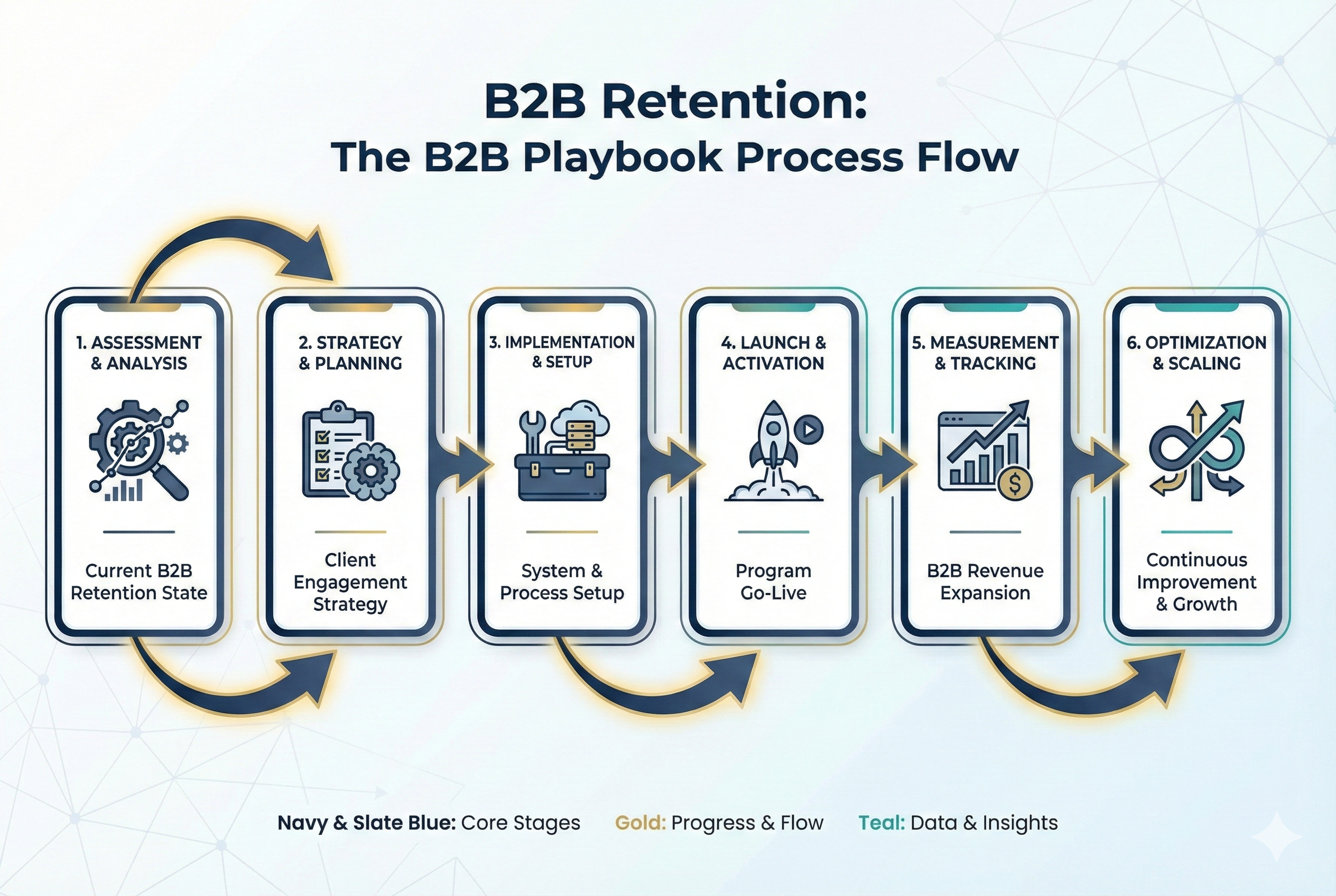
Moving from strategy to execution requires a systematic roadmap. Here's the proven framework for implementing B2B retention excellence:
Phase 1: Foundation (Months 1-3)
Objective: Establish baseline metrics and infrastructure
- Audit current retention rates by segment, tenure, and contract value
- Implement customer health scoring methodology
- Deploy early warning detection systems
- Train account teams on retention playbooks
Phase 2: Optimization (Months 4-6)
Objective: Improve retention drivers
- Launch structured QBR program
- Implement proactive success milestones
- Create expansion opportunity identification process
- Establish executive sponsor program
Phase 3: Scale (Months 7-12)
Objective: Systematize and automate
- Automate health monitoring and alerts
- Scale personalized engagement programs
- Implement predictive churn modeling
- Create client advocacy program
Implementation Priority Matrix
| Initiative | Impact | Effort | Priority |
|---|---|---|---|
| Health Scoring | High | Medium | P1 |
| QBR Program | High | High | P1 |
| Early Warning System | High | Low | P1 |
| Expansion Playbook | Medium | Medium | P2 |
| Advocacy Program | Medium | High | P3 |
Account Management Excellence
Your account management team serves as the frontline defense against churn and the primary driver of expansion. Equip them with the right frameworks and tools.
The CARE Framework
C - Continuous Value Documentation Maintain running records of value delivered. Update clients regularly on ROI achieved, problems solved, and strategic outcomes enabled.
A - Active Listening Train account managers to detect subtle signals of dissatisfaction. Often, clients telegraph concerns weeks or months before they become renewal risks.
R - Rapid Response When issues arise, response speed matters more than perfection. Acknowledge problems immediately, communicate resolution timelines, and follow through relentlessly.
E - Executive Alignment Ensure ongoing alignment between your executive sponsors and the client's leadership. These relationships provide air cover during difficult moments.
Segmentation Strategy
Not all accounts deserve equal retention investment. Segment your portfolio strategically:
| Segment | Characteristics | Investment Level |
|---|---|---|
| Strategic | High revenue, high growth potential | Maximum (white-glove) |
| Core | Solid revenue, stable | Standard (scaled) |
| Emerging | Lower revenue, high potential | Selective (growth-focused) |
| Maintenance | Low revenue, limited potential | Efficient (automated) |
KPIs and Metrics for B2B Retention
What gets measured gets managed. Establish a comprehensive metrics framework that provides leading indicators, not just lagging outcomes.
Primary Retention Metrics
- Gross Revenue Retention (GRR): Revenue retained excluding expansion
- Net Revenue Retention (NRR): Revenue retained including expansion
- Logo Retention Rate: Percentage of clients retained
- Customer Lifetime Value (CLV): Total expected revenue per client
Leading Indicators
- Health Score Trends: Directional movement in client health
- Engagement Metrics: Login frequency, feature adoption, support ticket patterns
- NPS/CSAT Scores: Satisfaction and likelihood to recommend
- Executive Relationship Score: Strength of sponsor relationships
Benchmark Targets
| Metric | Good | Better | Best-in-Class |
|---|---|---|---|
| Gross Revenue Retention | 85%+ | 90%+ | 95%+ |
| Net Revenue Retention | 100%+ | 110%+ | 120%+ |
| Logo Retention | 80%+ | 88%+ | 93%+ |
Key Takeaway: Track leading indicators obsessively. By the time lagging metrics show problems, you've already lost the battle. Early detection enables intervention.

Growth Strategies: From Retention to B2B Revenue Expansion
True B2B retention mastery doesn't just prevent churn—it fuels growth. Transform your retention program into an expansion engine.
The Expansion Flywheel
Land → Adopt → Expand → Renew → Advocate
Each stage feeds the next. Successful adoption creates expansion opportunities. Expansion strengthens renewal likelihood. Renewals generate advocates who drive new business.
Expansion Tactics
Cross-sell systematically: Map your full product portfolio against each client's potential use cases. Identify whitespace opportunities quarterly.
Upsell strategically: As clients grow and mature, their needs evolve. Position premium tiers and additional capabilities as natural evolution, not sales pitches.
Expand stakeholders: The more departments using your solution, the stickier the relationship. Identify adjacent teams who could benefit.
Deepen integration: Every new integration, workflow connection, and data feed increases switching costs and strengthens retention.
Revenue Expansion Plays
| Play | Description | Typical Uplift |
|---|---|---|
| Usage Expansion | Increase seats/usage within existing contract | 15-25% |
| Product Cross-sell | Add complementary products | 20-40% |
| Tier Upgrade | Move to premium tier | 30-50% |
| Multi-year Lock | Extend commitment for discount | Improved retention |
Action Plan: Your 30-Day Quick Start
Don't let this playbook become shelf-ware. Here's your immediate action plan:
Week 1: Assess
- Calculate current GRR, NRR, and logo retention
- Identify your top 20% of accounts by revenue
- Audit last 5 churned accounts for root causes
Week 2: Prioritize
- Implement basic health scoring (even manual)
- Schedule QBRs with top 10 accounts
- Identify 3 accounts showing early warning signs
Week 3: Act
- Launch intervention for at-risk accounts
- Document value delivered for strategic accounts
- Train account team on CARE framework
Week 4: Systematize
- Create retention dashboard
- Establish weekly retention review meeting
- Build 90-day retention improvement roadmap
Conclusion
B2B retention isn't a department responsibility—it's an organizational imperative. The companies that master client engagement and systematize retention excellence don't just survive; they build unassailable competitive advantages.
The frameworks in this playbook have been proven across thousands of B2B organizations. But frameworks alone don't create results. Execution does.
Start with one section. Implement it fully. Measure the impact. Then expand.
Your clients have chosen to partner with you. Honor that choice by becoming genuinely indispensable to their success. When you do, B2B revenue expansion becomes the natural outcome of relationships built on delivered value.
Ready to transform your retention strategy? Begin with your top 10 accounts this week. Schedule those QBRs. Document that value. The compound returns start with the first step.
Looking for tools to implement your B2B retention strategy? Explore how LoyalFlow helps enterprises build systematic client loyalty programs that drive measurable retention improvements.